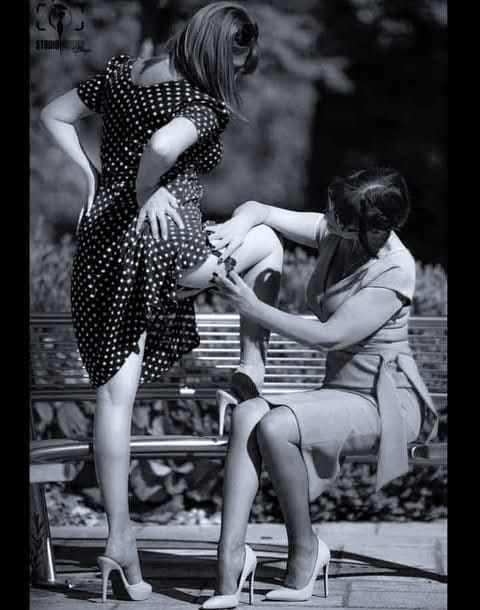

I’ve been thinking about the women who taught me how to be a woman. Not in any grand philosophical sense – I mean quite literally. The women who showed me how to roll a stocking properly, how to fasten a suspender without laddering the nylon, how to check my seams were straight. These weren’t lessons I learned from books or magazines. They were passed down, woman to woman, in bedrooms and bathrooms, with patience and the occasional gentle laugh at my fumbling attempts.
It strikes me that this is something younger generations may have missed entirely. When tights swept in and made everything so much simpler, we gained convenience but lost a whole tradition of shared feminine knowledge. There was something rather lovely about it, looking back. Something intimate and warm.
Let me tell you about the church hall.
Every community had one, didn’t they? That slightly draughty building with the parquet floor and the tea urn that was always on. Ours was the site of jumble sales, wedding receptions, and – once a year – the Ladies’ Variety Show.
If you’re too young to remember variety shows, they were gloriously amateur affairs. A bit of singing, a few jokes that made the vicar pretend not to hear, perhaps some magic tricks that fooled absolutely no one. The women of the neighbourhood would put it on, and everyone would come to watch and cheer and have a thoroughly good time.
But the finale – oh, the finale was something else.
The curtains would pull back to reveal a line of women in full can-can regalia. These weren’t showgirls from Paris. These were our neighbours. Our mothers. Mrs Henderson from number forty-two. The lady who worked at the greengrocer’s. Someone’s nan, for heaven’s sake. And there they were, in ruffled skirts and petticoats, ready to kick up their heels.
“These weren’t showgirls from Paris. These were our neighbours. Our mothers. Someone’s nan, for heaven’s sake.”
When the music started and the kicks began, you could see flashes of black stockings, suspenders, petticoats in a riot of colours. The women were laughing, some of them blushing, all of them having the time of their lives. The audience whooped and cheered. The children – us – watched with wide eyes, not entirely sure what we were feeling but knowing it was something important.
What I remember most, though, isn’t the performance itself. It’s what came before.
The hours of preparation in someone’s back room. The women helping each other dress, lending each other stockings when someone’s got a ladder at the last minute, adjusting each other’s suspenders, checking each other’s seams. The nervous giggles. The glasses of sherry “for courage”. The camaraderie of women doing something silly and wonderful together.
That was the sisterhood. That was what we were watching without knowing we were watching it. Women supporting women. Women being playful and bold and a little bit naughty, all in the safe company of each other.
But the real lessons came in quieter moments.
I remember the first time I was allowed to watch an older woman get dressed properly. It might have been my mother, an auntie, an older cousin – all of them, probably, at different times. In those days, women’s bedrooms and bathrooms were places of mystery for young girls. There were things hanging up to dry that we weren’t supposed to ask about. Bottles and powders on dressing tables. The fascinating architecture of corsets and girdles and suspender belts.
And at some point, when you were deemed old enough, you were let into the secret.
“Come here, love. Let me show you how this works.”
The first lesson was always about care. Stockings were expensive. You didn’t just yank them on like socks. You gathered the fabric carefully in your hands, made a little nest for your toes, then rolled – never pulled – the stocking up your leg. Slowly. Gently. Any snag from a rough fingernail or a ring could mean a ruined stocking and wasted money.
“You gathered the fabric carefully in your hands, made a little nest for your toes, then rolled – never pulled – the stocking up your leg.”
Then came the suspender belt. This required actual instruction because it wasn’t at all obvious how those little metal clips worked. How to thread the stocking top through. How to adjust the length of the straps so the tension was right – not so loose that they’d slip, not so tight that they’d be uncomfortable. How to fasten the back ones, which you couldn’t see, by feel alone.
And then, the final check. Stand up straight. Turn around. Look in the mirror. Are your seams straight? Because crooked seams simply would not do.
If they weren’t straight – and they never were, not on the first few attempts – a patient hand would show you how to adjust them. “Give it a little twist at the ankle, that’s it. Now smooth upward. There you are. Perfect.”
What strikes me now, looking back, is how much more was being passed down than just the mechanics of getting dressed.
We were learning that being a woman took effort. That there was a right way and a wrong way to do things. That details mattered – the straightness of a seam, the smoothness of nylon over the knee, the proper click of a suspender clip. We were learning to take pride in our appearance, not for vanity’s sake, but because looking after oneself was a form of self-respect.
We were also learning that this knowledge was ours. It belonged to us, the women. The men in our lives might appreciate the results, but they had no idea what went into achieving them. There was something rather delicious about that, wasn’t there? Knowing that beneath our demure skirts and sensible blouses was this whole secret architecture of clips and straps and silk, a hidden world that was entirely our own.

I remember, too, the sense of graduation. The first time I was trusted with “proper” stockings instead of knee socks. The first suspender belt that was mine, not borrowed. The first time I got my seams straight without help. These were milestones, as meaningful in their way as any birthday or school achievement.
“You’re a young lady now,” someone would say. And you felt it. You carried yourself differently. You had been initiated into something.
“The men in our lives might appreciate the results, but they had no idea what went into achieving them.”
I wonder sometimes if young women today feel the loss of this, even without knowing exactly what’s been lost.
There’s something missing when getting dressed is just a matter of grabbing whatever’s clean and pulling it on. Something lost when underwear is purely functional, chosen for invisibility rather than beauty. Something gone when no one ever takes you aside and says, “Here, let me show you. This is how the women in our family do it.”
Perhaps I’m being sentimental. Tights are certainly easier. Nobody has time in the morning for all that fussing with clips and seams. The world has moved on, and there’s much about modern life that’s better for women than it was in those church-hall days.
But I’m glad I learned. Glad I was part of that chain of knowledge, woman to woman, generation to generation. Glad I can still hear my auntie’s voice telling me to roll, not pull. Glad I still check my seams in the mirror every morning, even though there’s no one left to scold me if they’re crooked.
And I’m glad, too, for those can-can dancers in the church hall. For the sight of ordinary women being extraordinary for one night. For the flash of black stockings and the sound of laughter and the wonderful, unspoken message they were sending to all us little girls watching from the audience:
One day, you’ll be one of us. One day, you’ll know what we know. One day, you’ll kick up your heels too.
That’s the sisterhood of stockings. And it’s still going, for those of us who remember. For those of us who still roll, never pull. For those of us who still check our seams.
We’re still here, darlings. And we’re still kicking.